Research
My research investigates how human minds are integrated in, and mutually constituted by, the socio-material organization we build for ourselves.
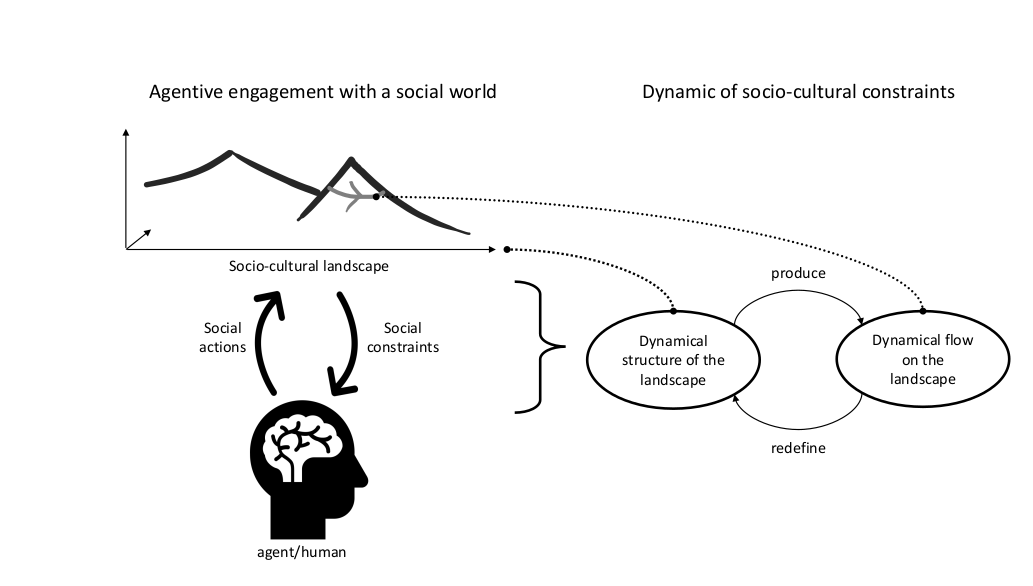
This starts from a simple observation: the material and cultural world we inhabit is not a pre-given stage for mental activity, but something we actively bring about through engagement with the world. The concepts which define our existence as cognitive agents, from the percepts that guide a hunter’s tracking to the constitution of a political community, are themselves defined by the complex ecology of socio-material practices by which we engage with the world.
Drawing primarily (but critically) from the Active Inference Framework, I attempt to demonstrate how cognitive and social science generally fail to make sense of the mutual constitution between mind and world; and to draw the conceptual and methodological consequences of this approach. I develop this question across three interlocking lines of work.
Unfolding landscapes of cultural affordances - Credit to Iona BRENAC
The philosophy-physics of creative evolution: Existing formal approaches to cognition and life, including the Free Energy Principle, presuppose the space of possibilities that cognitive systems evolve in. I argue that this fails to account for the construction of novel norms and concepts by human sociality, which are brought about as structuring entities of our experience and activity through our engagement with the world. I account for this through contextuality, the property of systems where observation brings about (rather than reveal) physical states, emerging from the thermodynamic irreversibility of measurement in multi-scale biological organization. In turn, the conceptual framework this suggests for reality as we experience it is participatory realism: the concepts through which we understand the world are real, but they is brought about through the very cognitive processes and socio-material practices by which we enact them.
The social organisation of cognition: Human cognition is not merely fed cultural content, but constituted by the socio-material context in which it develops. Under Active Inference, we can understand shared expectations over typical behaviour as social constraints: causal forces that canalise perception and action in the same sense that biological constraints do. Given the physical background of contextuality, we can further understand such constraints as contingent outcomes of our own engagement with the world rather than prior properties of our world or cognition taken in isolation. I argue that this process is a general property of cognition, but is characterized in its human form by the existential stance, our capacity to attend reflexively to our own activity and understand it as meaningful expressive acts. Social organisations then emerge from the closure of constraints in the shared socio-material landscape, thus grounding Wittgenstein’s intuition of sociocultural lifeforms in contemporary definitions of biological autonomy.
Applications across disciplines: Because this framework locates the structure of cognition in the socio-material practices that enact it, it has direct consequences for how we study mind and culture. In psychology, the contextuality argument implies that stimulus-response laws cannot hold for cognitive systems in general, motivating a cognitive frame analysis that studies how agents’ implicit frames constitute the meaning of experimental situations. In cultural evolution, Active Inference provides a computational foundation for modelling the open-ended reconstruction of social norms, rather than abstracting cognitive agency away from evolutionary dynamics. In the philosophy of history, the contextuality of social constraints motivates a cliodynamic realism that treats historical structures as real but irreducibly contextual, resisting reduction to dynamical laws. In the philosophy of mind, the framework grounds a process-ontological account of the extended mind (developed with Andy Clark), where cognitive boundaries are multiple and shifting rather than fixed. And in political theory, the biological autonomy of sociocultural lifeforms implies that social organisations cannot be redesigned from above, motivating an ecological redirection built on contextual knowledge rather than high-modernist planning.
Current status
- PhD student in Cognitive Science at the University of Sussex (Department of Engineering and Informatics) financed by the XSCAPE projet, under the supervision of Andy Clark and Chris Buckley, as a part of the XSCAPE project.
- Researcher for Kairos Research
- Scientific advisor for the Active Inference Institute
- Vice-president of the French Society of Cliodyamics
Publications
- Guénin—Carlut, Avel. 2026. “Development Is (Embodied) Intelligence - Biological Information, Agency, and Contextuality.” IOP Conference Series: Materials Science and Engineering 1343 (1): 012008. https://doi.org/10.1088/1757-899X/1343/1/012008.
- Guénin–Carlut, Avel. 2026. “Cognition in Eco, Cognition in Vitro: Measurement, Explanation, and Contextuality in Cognitive Sciences.” Intellectica, January 8, 89–116. https://intellectica.org/en/cognition-eco-cognition-vitro-measurement-explanation-and-contextuality-cognitive-sciences
- Guénin–Carlut, Avel, Jadranka Verdonkschot, Laura Désirée Di Paolo, Felipe Criado-Boado, Luis M. Martínez, and Andy Clark. 2026. “From Material to Cognitive Landscapes.” January. https://hal.science/hal-05471819.
- Guénin–Carlut, Avel. 2025. “Cognitive Agency in Socio-Cultural Evolution - A Proposal to Ground Social Modelling in the Active Inference Framework.” X7yr4_v2. Preprint, OSF Preprints, December 16. https://osf.io/x7yr4/.
- Guénin–Carlut, Avel. 2025. “Jeux Sérieux Pour Agents Énactifs - Une Ludique de l’enseignement Pour La Redirection Écologique.” Apnd5_v1. Preprint, SocArXiv, November 28. https://osf.io/preprints/socarxiv/apnd5/.
- Guénin–Carlut, Avel. 2025. “The Gap Is Relational - Open-Endedness, Biological Information, and the Limitations of In Silico ALife.” Preprint, OSF, May 12. https://doi.org/10.31219/osf.io/3u4wp_v1.
- Guénin–Carlut, Avel. 2025. “Agency and Contextuality in Cognitive Psychology - From Active Inference to (Cognitive) Frame Analysis.” Preprint, OSF, February 3. https://doi.org/10.31219/osf.io/et2wp_v1.
- Di Paolo, Laura Desirée, Ben White, Avel Guénin–Carlut, Axel Constant, and Andy Clark. 2025. “Material Culture Both Reflects and Causes Human Cognitive Evolution.” Behavioral and Brain Sciences 48 (January): e7. https://doi.org/10.1017/S0140525X2400092X.
- Guénin–Carlut, Avel, and Laura Désirée Di Paolo. 2025. “Repenser l’éducation et La Technologie Pour l’Anthropocène. De l’inférence Active à La Technopolitique Située.” Revue OEconomia Humana 2 (1): 1. https://crsdd.esg.uqam.ca/articles/repenser-leducation-et-la-technologie-pour-lanthropocene/
- White, Ben, Andy Clark, Avel Guénin–Carlut, Axel Constant, and Laura Desirée Di Paolo. 2025. “Shifting Boundaries, Extended Minds: Ambient Technology and Extended Allostatic Control.” Synthese 205 (2): 81. https://doi.org/10.1007/s11229-025-04924-9.
- Guénin–Carlut, Avel. 2025. “Contextuality, Cognitive Engagement, and Active Inference.” In Active Inference, edited by Christopher L. Buckley, Daniela Cialfi, Pablo Lanillos, et al. Springer Nature Switzerland. https://doi.org/10.1007/978-3-031-77138-5_17.
- Guénin–Carlut, Avel. 2025. “On Cliodynamic Realism - Is There Such a Thing as the ‘Dynamics’ of History?” Preprint, OSF, February 3. https://doi.org/10.31219/osf.io/7239k_v3.
- Guénin–Carlut, Avel, and Isaac Dubourg. 2024. “Power, Ritual, and Identity - A Cognitive Study of Conversion to the Unification Church.” Preprint, OSF, December 27. https://doi.org/10.31219/osf.io/wg36c.
- Constant, Axel, Laura Desirèe Di Paolo, Avel Guénin-Carlut, et al. 2024. “A Computational Approach to Selective Attention in Embodied Approaches to Cognitive Archaeology.” Journal of The Royal Society Interface 21 (219): 20240508. https://doi.org/10.1098/rsif.2024.0508.
- Baulin, Vladimir, Alex Vyatkin, Avel Guénin–Carlut, et al. 2024. FarmWorks: Decentralized AI Agents for Personalized Solutions. September 12. https://doi.org/10.5281/zenodo.13754586.
- Di Paolo, Laura Desirèe, Ben White, Avel Guénin-Carlut, Axel Constant, and Andy Clark. 2024. “Active Inference Goes to School: The Importance of Active Learning in the Age of Large Language Models.” Philosophical Transactions of the Royal Society B: Biological Sciences 379 (1911): 20230148. https://doi.org/10.1098/rstb.2023.0148.
- Guénin–Carlut, Avel, and Sarah Benazouz. 2024. Modelling the Social Construction of Preferences in Financial Economics - Toward an Active Inference Reconstruction of Minskyian Macroeconomics. July 15. https://osf.io/rfsv7/.
- Guénin–Carlut, Avel. 2024. “From the Existential Stance to Social Constraints - How the Human Mind Becomes Embedded in Our Social, Cultural and Material Context.” Preprint, OSF, July 9. https://doi.org/10.31219/osf.io/3kyzt.
- Guénin–Carlut, Avel. 2024. “Is the Ecological Redirection Possible? An ALife Perspective on Sociocultural Evolution in the Anthropocene.” Preprint, OSF, April 11. https://doi.org/10.31219/osf.io/bcyku.
- Guénin–Carlut, Avel, and Mahault Albarracin. 2024. “On Embedded Normativity an Active Inference Account of Agency Beyond Flesh.” In Active Inference, edited by Christopher L. Buckley, Daniela Cialfi, Pablo Lanillos, et al. Communications in Computer and Information Science. Springer Nature Switzerland. https://doi.org/10.1007/978-3-031-47958-8_7.
- Guénin–Carlut, Avel. 2023. “Strange Things, Statespace Representation, and Participatory Realism - Comment on ‘Path Integrals, Particular Kinds, and Strange Things.’ by Friston et Al.” Physics of Life Reviews 47 (October): 268–70. https://doi.org/10.1016/j.plrev.2023.10.027.
- Institute, Active Inference, Ander Aguirre, John Boik, et al. 2023. The Active Inference Institute and Active Inference Ecosystem. August 19. https://doi.org/10.5281/zenodo.8266281.
- Guénin–Carlut, Avel. 2023. Liquid Flywheel for High Pressure, Low-Tech Fluidyne Engine. August 1. https://osf.io/df2rm/.
- Guénin–Carlut, Avel, Ben White, and Lorena Sganzerla. 2023. “The Cognitive Archaeology of Sociocultural Lifeforms.” Paper presented at ALIFE 2023: Ghost in the Machine: Proceedings of the 2023 Artificial Life Conference. ALIFE 2023: Ghost in the Machine: Proceedings of the 2023 Artificial Life Conference, July 24. https://doi.org/10.1162/isal_a_00670.
- Guénin–Carlut, Avel. 2022. “Physics of Creation - Symmetry Breaking, (En)Active Inference, and Unfolding Statespaces.” Preprint, OSF Preprints, October 15. https://doi.org/10.31219/osf.io/68947.
- Guénin–Carlut, Avel. 2022. “Thinking like a State: Embodied Intelligence in the Deep History of Our Collective Mind.” IOP Conference Series: Materials Science and Engineering 1261 (1): 012026. https://doi.org/10.1088/1757-899X/1261/1/012026.
- Friedman, Daniel, Shaun Applegate-Swanson, Arhan Choudhury, et al. 2022. An Active Inference Ontology for Decentralized Science: From Situated Sensemaking to the Epistemic Commons. March 1. https://doi.org/10.5281/zenodo.6320575.
- Guénin–Carlut, Avel. 2020. Beyond State - Drafting a Prospective Anthropology. March 9. https://doi.org/10.17605/OSF.IO/EHQJS.
Research talks
- 2026 July 02: “Computation, Autonomy, and Contextuality - Comparing the organization of information in mechanical and biological systems”, Research conference at the Foundations of Computation Symposium.
- 2026 April 30: “The Common Ground of Socio-Material Engagement - Enactive psychiatry across scales and contexts”, Invited talk at the Sussex Centre for Consciousness Science.
- 2026 April 10: “Experiencing through other minds - Describing hypnosis as extended cognition”, Poster presentation at the Varieties of Externalism XSCAPE workshop, with Sarah Lelièvre.
- 2026 April 10: “Active Inference for Archaeology - Towards a methodology to reconstruct the common ground of social activity from material evidence”, Research conference at the Varieties of Externalism XSCAPE workshop, with Jadranka Verdonkschot.
- 2025 April 03: “Things that think are things that grow - Contextuality, development, and (embodied) intelligence”, Research conference at the 2025 Embodied Intelligence conference.
- 2025 March 17: “How can birds develop socio-sexual preferences? - Contextuality, robustness, and evolvability in the development of animal semiotics”, Invited talk at the University of Vienna Department of Behavioral & Cognitive Biology.
- 2025 March 09: “From Contextuality to Social Constraints - An Active Inference ontology for participatory realism and social change”, Invited talk at the Active Inference Institute. Video.
- 2025 February 20: “Active Inference for archeology - Towards a methodology to reconstruct the “common ground” of social activity from material evidence”, Invited talk at the INCIPIT.
- 2024 September 11: “Contextuality, Cognitive Engagement, and Active Inference”, Paper presentation, at the 5th International Workshop on Active Inference.
- 2024 August 30: “Active Inference in Archaeology: A Case Study in Embedded Normativity”, keynote talk at the From Material Landscape to Cognitive Landscapes XSCAPE workshop during the 2024 European Association of Archologists conference, with Jadranka Verdonkschot.
- 2024 August 08: “Active Inference: from the physics of cognition to social organization”, Invited talk, at the Emerging Researchers in Articifial Life town hall.
- 2024 July 26: “Modelling the social construction of preferences in financial economics - Toward an Active Inference reconstruction of Minskyian macroeconomics”, Research conference, at the 2024 ALife conference
- 2024 May 30: “Cognitive Contextuality, Material Culture, and Participatory Realism”, Research conference, at the Cultural Embedding of Social Cognition - The predictive processing and Active Inference approach workshop organized by the Cultural Embedding of Social Cognition project.
- 2024 May 30: “Engaging with Active Inference - A conceptual tutorial for social and cognitive scientists”, with Iona BRENAC, Tutorial, at the Cultural Embedding of Social Cognition - The predictive processing and Active Inference approach workshop organized by the Cultural Embedding of Social Cognition project.
- 2024 March 20: “Embodiement, Contextuality, and Material Engagement”, Research conference, at the 2024 Embodied Intelligence conference.
- 2023 October 20: “Identity capture in the Unification Church - An Active Inference account of power”, Research conference, at the Societies in Historical and Comparative Perspective conference.
- 2023 September 13: “On Embedded Normativity - An Active Inference account of agency beyond flesh”, with Mahault ALBARRACIN, Research conference, at the 4th International Workshop on Active Inference.
- 2023 August 22: “On Embedded Normativity”, Research conference, in the 3rd Applied Active Inference Symposium.
- 2023 July 28: “The Cognitive Archeology of Sociocultural Lifeforms”, Poster presentation, in the ALife 2023 conference.
- 2023 March 24: “Embodied Normativity”, with Manon JOB and Mahault ALBARRACIN, Research conference, in the Embodied Intelligence Conference 2023.
- 2023 March 16: “Creating material and cultural landscapes - A constraints ontology for multiscale socio-historical dynamics”, Research conference, in the Kiel Conference 2023: Scales of Social, Environmental, and Cultural Change in Past Societies.
- 2023 January 23: “Physics of Creation - Can the Free Energy Principle ground the construction of physical statespaces ?”, Research conference, in the Active Inference Institute Livestream. Video
- 2021 October 17: “Intelligence without creativity - Can Active Inference ground our understanding of life, mind and society ?”, Research conference, in Cognitio 2021. Open access slides and video
- 2021 October 16: “Thinking like a State - Embodied intelligence in the deep history of our collective mind”, Research conference, with Virginia Bleu KNIGHT and Daniel FRIEDMAN, in Cognitio 2021.
- 2021 June 29: “Grounding collective intelligence as Active Inference”, Research conference, with Daniel FRIEDMAN, in ACM Collective Intelligence Conference 2021. Open access slides & video
- 2021 June 10: “Social morphogenesis as enactive agency”, Discussion panel, in Cultural Evolution Society Conference 2021. Open access slides & video
- 2021 February 2: “Cognition in eco & cognition in vitro : can cognitive mechanisms explain ecological behaviour ?”, Invited talk, in French Federation of Students & Young Researchers in Cognitive Science (FRESCO)’s Journal club. Open access slides
- 2020 November 27: “Cultural evolution of psychedelics usage, and the “entropic brain” hypothesis”, Invited talk, in Cultural Evolution Online’s seminar. Open access notes
- 2020 May 5 & 26: “Do collective brains dream of cultural evolution ?”, Invited talk, in Frederic NEF’s “Structures et agents” class, ENS Ulm.
- 2019 March 30: “Is cognition an exemple of evolution ?”, Conference, in French Federation of Students & Young Researchers in Cognitive Science (FRESCO)’s Young Researchers Symposium.
- 2019 March 29: “The coevolution of ethics and power in large scale societies”, Invited talk, in Institute for Complex Systems - Paris Île de France (ISC-PIF)’s Coffee break.
- 2018 May 6: “Adaptive control & evolution in robotics”, Invited talk, in National Institute for Mathematical and Biological Synthesis (NIMBioS).
Organization
- 2026 April 10: Co-organization of the Varieties of Externalism XSCAPE workshop, with Ben White, Axel Constant, Laura Désirée Di Paolo, and Andy Clark.
- 2024 August 30 : Co-organization of the From Material Landscape to Cognitive Landscapes XSCAPE workshop during the 2024 European Association of Archologists conference, with Jadranka Verdonkschot.
- 2024 June 7 : Co-organization of the Material Engagements XSCAPE workshop, with Andy Clark, Axel Constant, and Laura Désirée Di Paolo
- 2024 July to November : Organization of the Active Inference for the Social Science course